A little about the Lock-tail selected Gin’s …
The history of Gin is long a colourful one. A few years back, I was fortunate enough the see Maeve Marsden and Libby Wood perform their own story of Gin – Mother’s Ruin: A Cabaret About Gin. Still one of the best shows I have ever seen, and a great way to get a ‘mostly historical’ taste of Gin and the depth of its history, plus some great classic hits, reworded to celebrate Gin. I hope they reprise it someday, I will certainly be buying tickets. You can get a small taste still on this YouTube trailer from the 2017 Sydney Festival.

THE HISTORY OF GIN
If you are also interested in a much more comprehensive, deep-dive, into the history of Gin, I once again recommend Simon Difford, and his Difford’s Guide website. It is such a valuable and well constructed goldmine of history and content for the cocktail aficionado. His history of Gin discussion starts here.
For me, I think about it like one of those evolutionary charts you may have seen in high school, with a smaller number of ancestors, leading to an every greater number of later ‘evolutions’. For Gin, this is the human history of distillation, and that is an ancient history dating at least as far back as Alexandria in Roman Egypt in the first-century over 2,000 years ago.
This branch eventual moves into other spirits, Brandy (‘burnt wine’), Whisky, Vodka, and of course Gin. We will look at some of the others later. Simon Difford’s article runs through the move of Middle Eastern distillation through Europe, the addition of Juniper berries in around the 11th Century and the belief for centuries that these changing distillates could be a remedy for the plaque and conditions of the stomach, liver and kidneys. By the 16th Century, the Dutch are credited with a distillate known as Genièvre that is an early version of what today we call Gin. Written evidence exists from 1552.
Then the branches divide again, Dutch Jenever, English Gin, and eventually the contemporary renaissance of Gin, where there are literally thousands of Gins, from classics to newly conceived interpretations, with botanical variations of almost unlimited variety. However at the heart, Gin must contain Juniper berries or it isn’t Gin.
So let’s take a look at what this all means for ‘mixing cocktails’. Especially in the context of this ‘Lock-Tail’ journey that starts with Cocktails from the 1800’s and moves through the 1900’s and into today’s progression of Gin and Gin-based cocktails.
STYLES OF GIN
For the sake of simplicity and direct relevance to the ‘Lock-tail’ exploration, I am only going to include Gin styles (and brands) as we address them in the cocktail mixes (or a little in advance).
GENEVER (JENEVER, HOLLANDS, OR GENEVA)
Lighter on Juniper, the Dutch Spirit was the first Gin. Genever has its own sub-styles (oude, jonge, grain, aged, malt and others). Less commonly available than other styles of Gin, they are having a resurgence. In this ‘Lock-tails’ site and cocktail journey I have not used any Genever styles. Mostly because as the ‘Golden Age Cocktails’ started in the mid-to-late-1800’s, Genever was on the decline, and Old Tom Gin and then London Dry were coming into ascendancy. In the 1800’s Cocktails and early-1900’s, you could authentically use an Oude-style Genever (such as Bols Genever) if you wanted to try varying the style.
OLD TOM GIN
The predominant English style of the 18th and early 19th Centuries, before distilling processes advanced further in the mid-1800’s. Old Tom Gin had sugar and other flavour agents added to ‘hide’ some of the less pleasant flavours that remained within the base spirit. Early versions used sugar, lemon, aniseed, licorice and even turpentine. Old Tom’s remained in use until the mid-1900’s as London Dry progressively became the dominant style. In recent years, Old Tom style Gins have returned (without the turpentine) and some great varieties are available for mixing in classic (1800 and early 1900) cocktails.
LONDON DRY GIN
Beginning soon after the invention of the ‘Coffey’ continuous still in 1831, enabling an almost pure (highly rectified) spirit where unpleasant flavours could be extracted and sugar and other ‘covering’ agents were no longer required. The style is about the ‘process’ and not the city, with London Dry Style (sugars and sweeteners are prohibited) being able to be manufactured anywhere in the world. From the late 1800’s, London Dry became the dominant style of Gin.
OTHER STYLES
There are plenty of other styles of Gin, that don’t qualify as ‘London Dry’ due to their low Juniper content, sweeteners, or other ingredients. When the Juniper is low or non-existent, they are really moving more to ‘white spirits’ rather than Gin. When sweeteners are added, or post-distillation botanicals for sweet flavour, they are more in the realm of a ‘Gin Liqueur’, and then there are new concoctions that have their own class.
SLOE GIN
Sloe Gin is really a ‘Gin Liqueur’, rather than a true Gin. Although due to its age (early origin) and history, it is the only Gin Liqueur that doesn’t legally require the word ‘Liqueur’ after the variety. Made with ‘Sloes’, a fruit relative of the plum, they are much sweeter and have a darker (red) colour. Very different to the other Gin varieties and with a very different place in cocktails.
SUGGESTED GIN COLLECTION
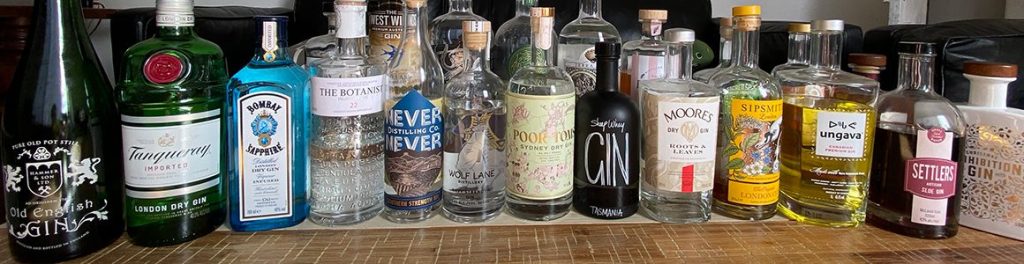
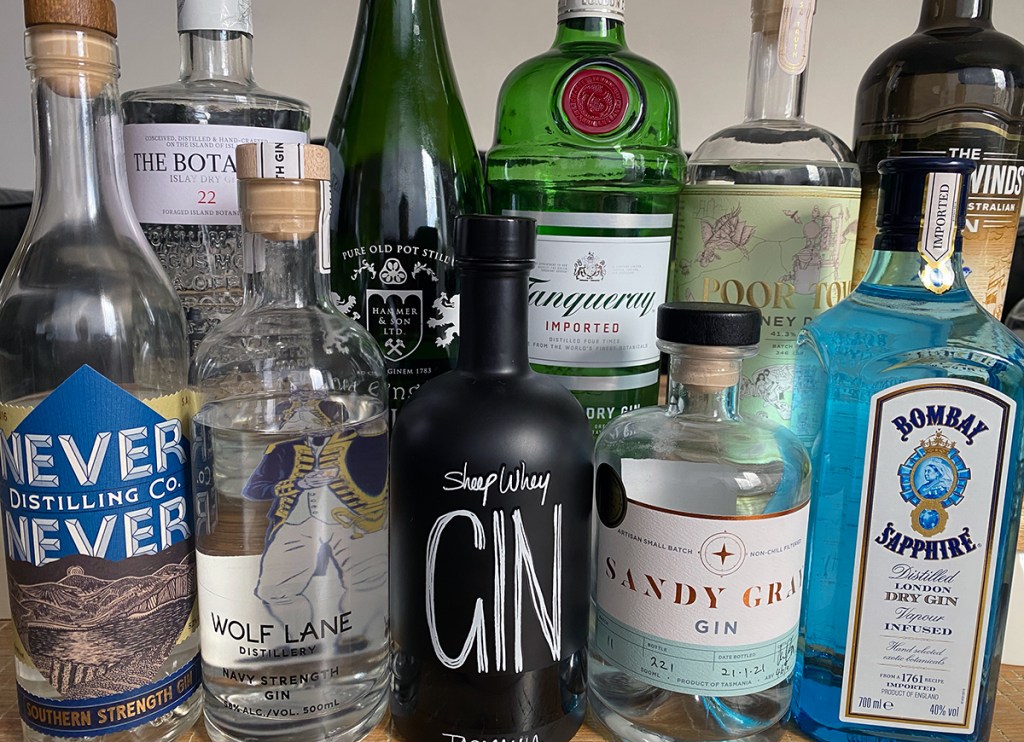
The following Gins have been (or will be) used in the ‘Lock-Tail’ recipes explored on this website.
If ‘Gin’ cocktails are ‘your thing’, then you may like to collect as many of these (and more) that suit your palate and your desire for mixing cocktails.
Here is a brief description of each ‘Gin’ used on this ‘Lock-tail’ journey:
Hammer & Son – Old English Gin (West Midlands, UK -44% abv)
Cocktails #016 Ramos Fizz, #018 Clover Club, #019 Hanky Panky, #021 Negroni, #036 – Salty Dog.
Made to a 1783 recipe using ‘Angela’, the oldest operating still in Great Britain. Made in an ‘Old Tom’ style, it is a Juniper forward gin with the sweetness associated with Old Toms. Perfect for late 1800 and early 1900 cocktail recipes. A high quality mixing Gin that could be used in all the early Lock-tail Gin mixes.
The Botanist (Islay, Scotland -46% abv)
Cocktails #003 John Collins, #006 Dry Martini, #011 Tailspin.
Effectively the ‘Lock-tail’ suggested ‘house Gin’ if you can only buy one Gin. Almost perfectly balanced, and despite 31 botanical (22 local Scotish ones), rather than strong flavours that could clash in cocktail mixes, the range keeps any from dominating. A perfect mixing gin, part classic and part contemporary.
Wolf Lane Distillery – Navy Strength (Cairns, Queensland -58% abv)
Cocktaila #008 Gimlet, #059 Army & Navy.
Winner of best Australian and best Navy Strength Gin Guide awards in 2020, this Cairns Distillery is making a mark on the international stage. Made as a homage to traditional Royal Navy gin, this has strong citrus notes of finger lime and grapefruit. Ideal when mixes call for navy strength and matched with citrus.
Poor Toms – Sydney Dry (Sydney -41.3% abv)
Cocktail #010 Martinez.
Sydney friends Jesse and Griff (both middle name ‘Tom’) were trained by Marcel Thompson from Gordons and Tanqueray, using a copper still imported from Germany. With citrus, apple, strawberry and chamomile notes, ‘Poor Toms’ works well where some sweetness and floral notes suit the cocktail.
Hartshorn – Sheep Whey (Tasmania -40% abv)
Cocktails #014 Last Word, #015 The Bronx, #022 Singapore Sling.
Like ‘The Botanist’ above, if you can only buy one Gin, then this is also an option. Made using Sheep Whey, the Gin leaves a sweet and smooth mouth feel, reminiscent of Old Tom gins, but without the sweetening agents. With only a small selection of botanicals, it makes this another perfect mixing Gin.
Sandy Gray – Gin (Tasmania -46% abv)
Cocktail #024 Aviation.
Created in a classic London Dry Style, this is certainly a dry gin (not sweet). The distiller has kept the alcohol level up to boost flavour carrying and the core palate is juniper (of course) with some cardamon and heat from Tasmanian Pepperberry. Great for a cocktail that benefits from a little spice and ‘warmth’.
Never Never Distilling Co – Southern Strength (South Australia -52% abv)
Cocktails #026 White Lady, #027 Southside.
Winner of the ‘World’s Best Classic Gin’ at the 2019 World Gin Awards. This South Australian Gin is all about the Juniper, great for cocktails where you want to make sure the drinker knows they are having Gin. This Gin also has some heat and works with most of these classic cocktails and a good Gin and Tonic.
West Winds – Cutlass (Western Australia -50% abv)
Cocktail #029 French 75.
The Cutlass holds claim to being Australia’s most awarded Gin. It is a ‘new world’ style with pine, eucalyptus, pepper and other savory notes. It won’t work with every cocktail, especially sweet mixes, but goes well in a Gimlet and I think pairs well with Brut Champagne in a French 75 and Australian cocktails.
Tanqueray – London Dry (Great Britain -40% abv)
Cocktail #060 Bee’s Knees.
Using a recipe unchanged since 1830 in a 200 year old copper pot still called ‘Old Tom’, this is a legitimate choice for classic cocktails calling for London Dry Gin. Juniper forward with crispness from angelica and coriander, it is hard to go past Tanqueray as a base spirit for London Dry cocktail mixes.
Bombay Sapphire – London Dry (Great Britain -40% abv)
Not used in the Locktails (yet).
Created in 1986 and now owned by Bacardi, it basically led the Gin revival during the ‘cocktail resurgence’ of the 1990’s. Gin was languishing, with old, tired brands, that had no appeal to new generations of drinkers. Every new boutique Gin can thank Bombay Sapphire for starting a renaissance of Gin. The flavour may be a little light for many, but this is a great Gin to introduce non-Gin drinkers to Gin.
Prohibition Liquor Co. – Bathtub Cut Gin (South Australia -69% abv)
Cocktail #031 Fallen Angel.
This South Australian producer has a range of great Gins. With the ‘Bathcut’, they wanted to recognise that period in US history (1920-1933) with this product. An extra post-maceration juniper addition adds some colour and increases the juniper strength. The target ABV of 69% was a cheeky inclusion and makes this a truly heavy hitter (and highly flammable). This Gin takes some serious flavours, usually of the citrus variety to bring it into balance, unless you are going to sip it neat or over ice.
Jensen’s – Old Tom Gin (London -43% abv)
Cocktails #037 Sea Breeze, #057 Suffering Bastard.
Made in London to an 1840’s recipe found in a Distiller’s notebook, this is a true ‘Old Tom’ style Gin, produced by Bermondsey Gin near the Tower Bridge in London. Not overly heavy with Juniper, and a sweetness without adding sugar after distillation, this Gin has a pleasant balance of citrus, pine and lavender notes with a little spice and heat that work extremely well in cocktails, especially the classics.
Blackmans Bay – Botanical Gin (Kumquat Batch, Tasmania – 43% abv)
Cocktail #045 Cosmopolitan (1934 version).
Handcrafted and producing only 250 bottles at a time, each ‘batch’ has a different result depending on the selected botanical expression for each. For this cocktail, it was a ‘Kumquat’ inclusion that added additional tart citrus to this 1934 cocktail. Very smooth, another quality small batch Gin from Tasmania.
Plymouth Gin – Classic London Dry (Plymouth, England – 41.2% abv)
Cocktail #069 London Fog.
One of the most famous Gin brands in the world. The recipe dates back to 1793 and some of the Black Friars distillery dates back to 1431. Plymouth Gin was provided in a launch-kit with every commissioned Royal Navy ship, and is the most authentic Gin for English naval recipes. Even better, it is a subtle and great Gin perfect for cocktails. Strong on citrus and juniper but subtle with other botanicals.
More to come.
 Lockdown Cocktails