A little information about Rum for the ‘Locktail’ re-discovery journey …
The history of Rum is inseparable from the history of sugar production and colonial expansion. Sugar Cane existed in pre-history in New Guinea and was fermented in places like India over 2,000 years ago. The systematic distillation of sugar-cane based spirit seems to have developed in Brazil, in the early 1500’s after the Portuguese introduction of sugar cane. The Brazilian slaves in Portuguese-owned sugar mills began distilling the fermented sugar-cane-juice into a spirit called ‘Pinga’, later to become known as Cachaça, still the celebrated Brazilian national spirit.
In the 1600’s, Caribbean plantation workers discovered that the molasses could be fermented and distilled, creating the earliest forms of Rum. Sales to the British Navy brought in extra revenue for the plantations and the naval presence also helped deter pirates and other commercial disruption. In 1655 Admiral Penn of the Royal Navy captured Jamaica from the Spanish and authorized the use of the local sugar-spirit as a navy ration, replacing the need to supply more perishable beer. The ‘Rum Ration’ was made official by the Navy Board in 1731 and lasted for 239-years until it ended on ‘Black Tot Day’ 31 July 1970. The sailors and Admiralty also introduced Rum’s favorite partners, Lime Juice and Sugar, as part of the fight against Scurvy and the reason why Royal Navy Sailors became known as ‘Limey’s’.
Whether Rum (English), Ron (Spanish), Rhum (French), this stable spirit spread around the world. Before the American Revolutionary War (1775–1783) it is estimated every American consumed around 14-litres of Rum each year and its trade was unfortunately closely connected with the slavery trade and in some cases acted as a defacto currency.
Rum also led to Australia’s only ever military coup. Governor William Bligh outlawed the use of Rum as currency in 1808, to which the NSW Corps marched on Government House, arresting and deposing Bligh until his replacement Lachlan Macquarie arrived in 1810.
THE STORY OF BALMAIN (AND GILCHRIST) AND RUM
On 26 April 1800, the second Governor of New South Wales, John Hunter, granted 550 acres to Colony Surgeon William Balmain (1762–1803) for his services. This allotment, often called the ‘Balmain Grant’ contains the contemporary suburbs of Balmain, East Balmain and Rozelle (formerly West Balmain). Balmain held the peninsular for less than 15-months, transferring the land in full to John Borthwick Gilchrist (1759–1841) on 7 July 1801 for 5 shillings, days before leaving Sydney with his wife and daughter.
Gilchrist never landed foot in Australia, but ended up owning the entire Balmain peninsular for 5 shillings, the settling of an illicit trade debt that involved Governor Hunter, Captain John Macarthur, Balmain and Gilchrist. Gilchrist and contacts of Captain Macarthur’s in India, purchased a ship called the Thynne and provisioned it with 9,000 gallons of rum which sailed into Port Jackson on 11 January 1800. Bringing to the young colony rum worth more than £9,000 on the Sydney market of the day (about $2-million in 2020 equivalence).
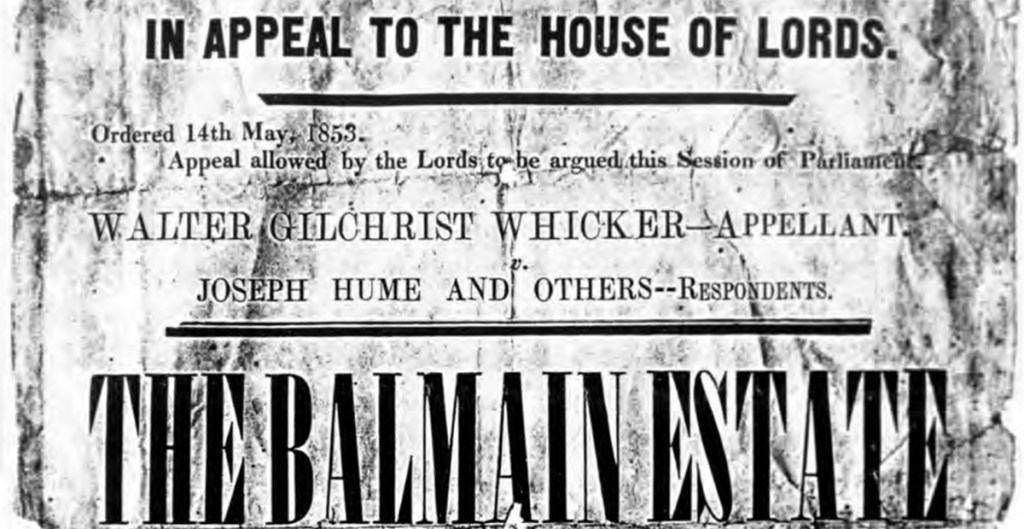
The Rum-originated ‘ownership dispute’ between the legal heirs of Balmain and Gilchrist lasted for almost 5-years until it reached the House of Lords in the UK in 1853, dramatically slowing the colony’s development of the Balmain Peninsular in the early days of the Sydney colony.
REGIONS, STYLES AND TYPES OF RUM
For the sake of simplicity and direct relevance to the ‘Lock-tail’ exploration, I am only going to include Rum styles (and brands) as we address them in the cocktail mixes (or a little in advance). The history, range, flavours, types and complexities of Rum are, as you would expect, enormous.
PUERTO RICO AND CUBA
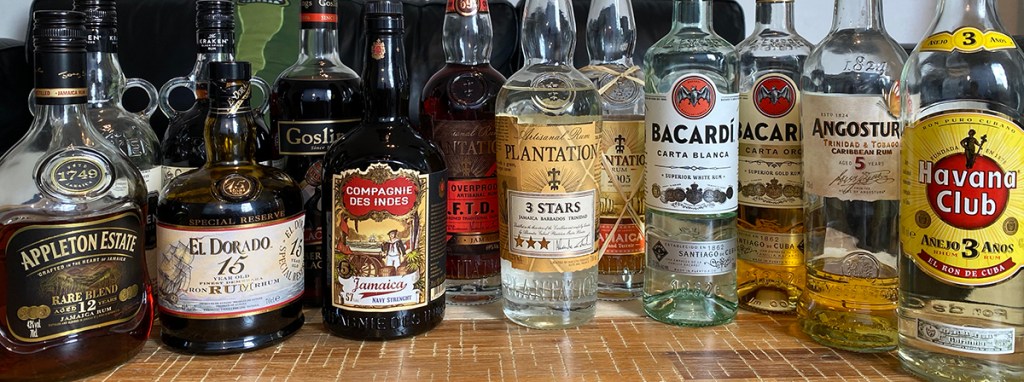
One of the most famous, if not the most famous Rums in the world is Bacardí, founded in Cuba in 1862. Strong opponents of Castro Government, all of their Cuban assets were confiscated by the Communist Cuban Government on 14 October 1960. Forcing Bacardí to move operations primarily to Puerto Rico. Bacardí is one of the largest spirits companies in the world, owning more than 200 other brands. Havana Club is still made in Cuba, and the brand is owned by Bacardí in the USA.
Cuban and Puerto Rican Rum is generally light to moderate in flavour with a strong alcohol kick, and it is one of the largest producing regions for white, light, and gold coloured Rum. Most commonly used for Daiquiri’s, Bacardí Cocktail, Piña Colada, Cuba Libra, and Mojito.
TRINIDAD AND TOBAGO
A small island with a big Rum history. The key distillery is Angostura’s producing their own Rum and other branded versions. More floral and sweet that Puerto Rico and Cuba, but similar and can be substituted for many cocktails.
JAMAICAN
A great region for enjoying smaller-batch and more artisan ‘pot-still’ varieties. Vibrant and more pungent with ‘funkiness’ and ‘hogo’ that Rum aficionados use to describe the strong but desirable and almost gamey flavour they seek in flavour rich medium-to-darker colour Rum. Appleton is one of the larger Jamaican brands, however there are many more. Often needed in Tiki Culture cocktails such as Donn Beach’s ‘Zombie’.
GUYANA – DEMERARA RUM
Like Angostura in Trinidad and Tabago, there is one major Demerara Distiller that created the majority of Demerara Rum. Their El Dorado brand of aged Demerara Rum is perhaps the best know and called for in rich and Tiki Culture cocktails. It has a stickier, sweeter and almost smoky flavour that is very rich. The quality aged Rum’s are expensive but hard to replace in cocktail that call for this flavour.
OTHER REGIONS AND TYPES
There are so many left unsaid, as you explore more and more into the world of Rum. Barbados, USA, Australia and so many other regions. There are related sugar-based spirits, Rhum Agricole, Cachaça and even sugar based white-spirit versions of Vodka and Gin. Not to mention spiced rums and other infusions and liqueurs. I can’t get to them all and will expand this resource as they are called for in the cocktails.
My only advice, if you are starting an exploration of Rum, don’t stop at your local Rum example (for example Bundaberg in Australia), you really don’t know how much or little you like Rum until you have at least tried a quality example of Puerto Rican, Jamaican and Demerara Rums as a minimum.
SUGGESTED RUM LOCKTAIL COLLECTION
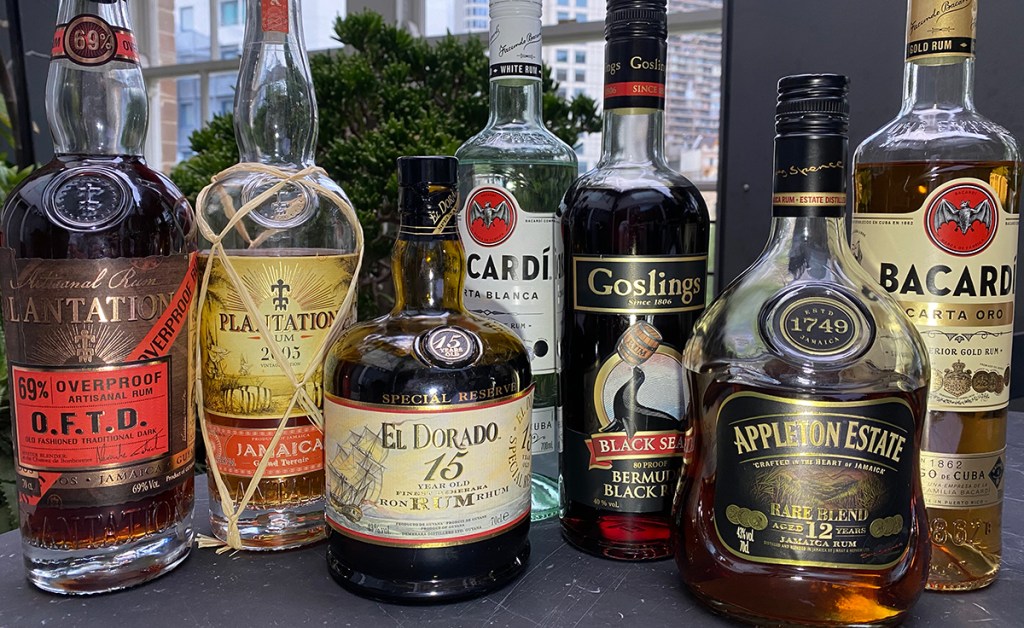
The following Rums have been (or will be) used in the ‘Lock-Tail’ recipes explored on this website.
If ‘Rum’ cocktails are ‘your thing’, then you may like to collect as many of these (and more) that suit your palate and your desire for mixing cocktails.
Here is a brief description of each ‘Rum’ used on this ‘Lock-tail’ journey:
Bacardí Carta Blanca (White Rum, Puerto Rico -37.6% abv)
Cocktails #013 Daiquiri, #020 Mojito, #034 El Presidente, #039 Bacardí Cocktail, #061 Piña Collider, #065 Blue Hawaii.
The best known White Rum in the World and a must for any Cocktail making collection. Play with your white rum or gold rum inclusions to taste, but start your Daiquiri, Bacardí Cocktail and Mojito exploration with this classic and quality Rum. Also likely to be what your customer is expecting in these cocktails.
Plantation – 3 Stars White Rum (Blend (Jamaica, Barbados, Trinidad) -41.2% abv)
Cocktails #020 Mojito, #056 Beachcomber, #074 Harpoon, #075 Flying Grasshopper.
Plantation are a highly regarded producer of a large variety of single location and blended Rums. There relatively recent 3-stars White Rum is a favorite of many mixologists in ‘White Rum Cocktails’. Slightly stronger and sweeter in flavour than Bacardí Carta Blanca, this makes a good alternative to explore.
Goslings Black Seal (Bermuda -40% abv)
Cocktail #028 Dark & Stormy.
A very dark rum (almost black), originally sold after WWI in reclaimed champagne bottles with a ‘Black Seal’ in wax. It is the registered trademark holder for the Dark & Stormy cocktail and the only authentic choice to make this famous cocktail with the right visual look. A fine Rum for this sweet cocktail, it lacks sweetness and depth for many other Rum cocktails.
Plantation – Aged Jamaican Vintage (In my case 2005, Jamaica -45.2% abv)
Cocktail #028 Safe Harbour, #043 Zombie, #052 Mai Tai.
A great example of a single location (Jamaican) aged rum, this is a great example of Rum when it is made more like single-malt Whisky. I have used this rich flavour (funky) Rum in my ‘non-branded’ version of the ‘Safe Harbour’ cocktail. A great quality Rum for any collection for drinking or sipping neat.
Havana Club (Cuba -40% abv)
Cocktails #034 El Presidente, #038 Mary Pickford, #046 Hemingway Special.
Still made in Cuba, although owned by Bacardí at least in the USA. This is an alternative to Bacardí Carta Blanca (White Rum) and feels like the right historical choice (or perhaps Bacardí) for the Cuban ‘El Presidente’ cocktail. It is a good quality White Rum for it’s relatively low cost.
Bacardí Carta Oro (Gold Rum, Puerto Rico -37.5% abv)
Cocktail #039 Bacardí Cocktail, #043 Zombie.
Less well known than Bacardí Carta Blanca (white rum), this is a lovely rum, slightly more flavour than the carbon-filtered white rum. For cocktails where a little colour is suitable, I prefer using this ‘light-gold’ rum to the clear variety.
Plantation O.F.T.D. (Overproof (Jamaica, Barbados, Guyana) -69% abv)
Cocktails #043 Zombie.
A great dark Rum blend and super potent. When a cocktail calls for OP (over proof), high flavour and dark, this is a great choice. For ‘flaming’ (set-on-fire) versions of cocktails, such as Tiki cocktail versions, this is a great choice. Also a great Rum option for the #028 Safe Harbour cocktail.
El Dorado – Aged Demerara Rum (10/12 or 15 years, Guyana -43% abv)
Cocktails #043 Zombie.
Demerara Rum is a specific type, coming principally from Guyana. El Dorado is the distilleries own brand and is an amazing high quality sipping Rum. Rich with demerara sweetness, syrup and a sweet smoky flavour. This is a great (but expensive) Rum for any collection and needed in many Tiki cocktails.
Rhum J.M – V.S.O.P. (Martinique -43% abv)
Cocktails #052 Mai Tai.
Starting with 3-years in re-charred Bourbon barrels, there are of course toasted oak flavours with the toffee and brown sugar that come from the molasses rhum base. Some smoke and the normal grass-iness that comes with Rhum Agricole. A good choice for sipping if you like smoky agricole and great for Tiki cocktails.
More to come.
 Lockdown Cocktails